
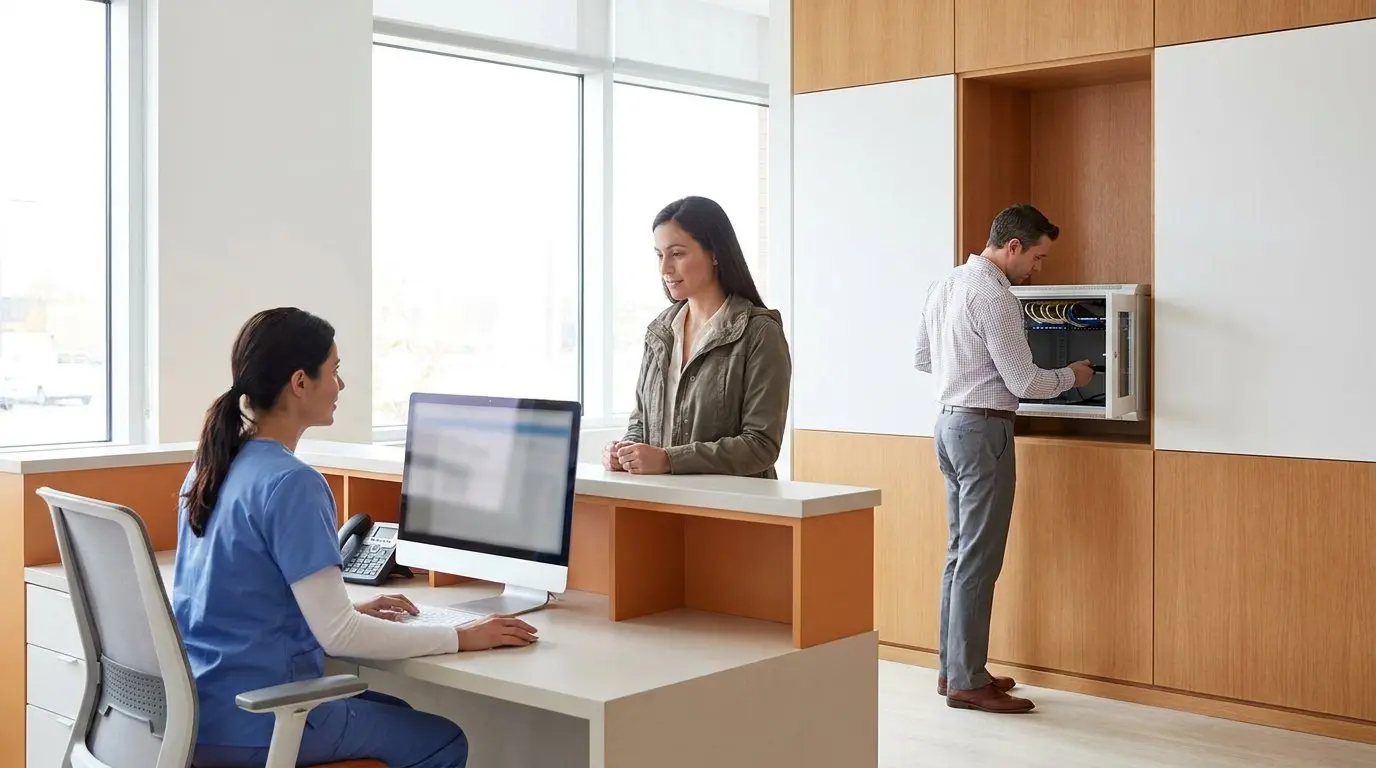
A medical group with three, five, or ten locations is really several practices sharing one name, one patient database, and one reputation. Each office has its own front desk computers, its own internet connection, its own printers and phones, and often its own history of how things were set up. Over time those locations drift apart, and the weakest one sets the security level for all of them.
We run four offices ourselves, in Kennett Square, Wayne, Media, and Bethlehem, so we know how quickly small differences between locations turn into real problems. Here is what managed IT should look like for a multi-site medical group, and why the stakes keep rising.
Why Multi-Site Medical Groups Are a Target
Healthcare is one of the most attacked industries in the country. According to the HIPAA Journal analysis of HHS breach data, 2025 set a new annual record with 772 large healthcare data breaches reported, and hacking and other IT incidents caused more than 80% of them.
Multiple locations widen the opening. Every clinic adds devices, user accounts, and network connections, and attackers only need the one that was missed: an unpatched computer at a satellite office, a shared password at a front desk, or a network where guest Wi-Fi and clinical systems sit side by side. Once inside one location, an intruder can often reach the shared systems that connect them all.
One Standard, Every Location
The fix is a single standard applied to every site. Every computer and server runs the same next-generation antivirus and endpoint detection and response, with SNAP-Defense providing managed detection and response (MDR) and a security operations center (SOC) behind them. Every mailbox gets the same Advanced Email Security, which uses AI to catch the phishing and impersonation emails that target front desks and billing teams. Every login uses unique passwords and multifactor authentication.
It starts with knowing what you have. We build and maintain a complete inventory of the equipment at every location and a map of how your network connects them, so nothing at a satellite office goes unmanaged. Clinical systems are kept separate from guest Wi-Fi and other devices that don’t need to reach them, and patches roll out to every site on the same schedule.
Keeping Every Clinic Connected
When the electronic health record, scheduling, phones, and email all run through the internet, a single outage can stop patient check-in cold. Wireless redundant internet gives each location a backup connection, so computers, security systems, and phones keep working when the main line goes down.
Phones matter just as much in a medical office. With VoIP phone service, every location runs on one system, with voicemail to email and the ability to move a live call from a desk phone to a mobile phone. Providers and staff who split time between clinics or work from home connect through managed remote access, so they reach what they need without opening a hole in your network.
Backups That Can Bring a Clinic Back
Ransomware is designed to encrypt your data and your backups at the same time. Advanced Cloud Backup keeps immutable copies, including granular Microsoft 365 backup, so the backup itself can’t be altered or deleted by an attacker. What matters most is how fast a location can be running again, and that is something to plan and test before you need it.
What the Proposed HIPAA Security Rule Update Would Require
In January 2025, HHS published a proposed update to the HIPAA Security Rule. As proposed, it would require covered entities to:
- Keep a written inventory of technology assets and a network map, reviewed at least every 12 months.
- Encrypt electronic protected health information at rest and in transit, with limited exceptions.
- Run vulnerability scans at least every six months.
- Perform a penetration test at least once every 12 months.
- Be able to restore critical systems and data within 72 hours of a loss.
Whatever form the final rule takes, the direction is clear, and every item on that list is work a managed IT provider should already be doing at every one of your locations. A penetration test and a cybersecurity audit are the fastest way to see where you stand today.
Compliance You Can Show
Pegasus helps clients achieve compliance with HIPAA, NIST 800-171, the CIS Critical Security Controls, CMMC, FINRA, and other frameworks, and our staff are regularly trained on the latest standards. We have earned the HIPAA Seal of Compliance from Compliancy Group, and client data we store is encrypted in SOC 2 datacenters. Every flat-rate managed IT client also gets cybersecurity awareness training and assessment for their staff, which matters in a front office where one click on the wrong email can expose patient records.
Planning matters too. Our post on how multi-site medical groups can reduce long-term tech expenses covers replacing equipment on a schedule across every clinic, and our guide to healthcare compliance covers the basics of HIPAA and IT.
The Same Team for Every Location
A multi-site group needs a partner who knows every location, including the newest one. With Match-IT, your group works with a dedicated pod of four to six people who learn your systems, your locations, and your staff, and then stay with you. When the front desk at your newest clinic calls for help, the person who answers already knows how that office is set up.
Running more than one location? Talk to our team about bringing every clinic up to one standard.
Related guides