
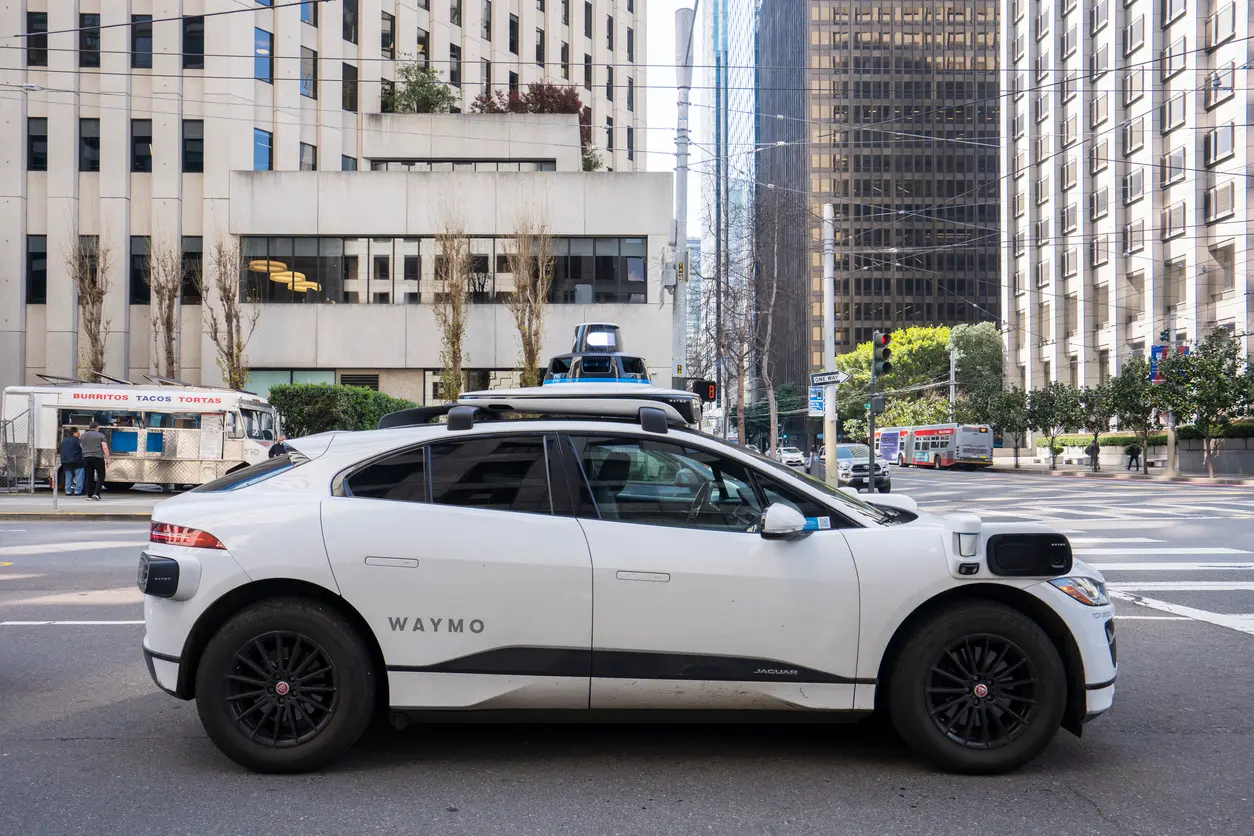
The future of transportation is arriving faster than many expected, and Philadelphia is now one of the newest testing grounds for autonomous taxi service. Waymo, the self-driving technology company owned by Alphabet, has already deployed driverless taxis in Phoenix, San Francisco, Los Angeles, Austin, and Atlanta. Now, their unmistakable white-and-teal Jaguar I-PACEs are appearing on the streets of Philadelphia as part of expanded real-world testing. For a closer look at the technology in action, you can view their self-driving Jaguar here: Waymo.
Waymo’s vehicles are designed to navigate dense urban streets as well as fast-moving highways, and early reports confirm that the company’s cars have successfully traveled on major Philadelphia routes, including I-95 and I-76. Their presence marks a significant step forward in autonomous mobility for the region. As testing continues in Philadelphia, New York, and Boston, national attention around Waymo’s expansion has grown. Local coverage offers an early glimpse at what residents may soon experience firsthand: 6ABC coverage of Waymo testing in Philadelphia.
The big question for many Philadelphians is simple: Would you ride in a driverless taxi? Early data suggests that autonomous vehicles may already be outperforming some human drivers. Reports indicate that Waymo’s sixth-generation robotaxis are demonstrating safer driving patterns, fewer mistakes, and smoother trip execution compared to average Uber drivers. Some riders even report lower fares and, of course, the absence of tipping pressure. An in-depth breakdown of performance comparisons can be found here: Waymo Robotaxi Performance.
A few members of the Pegasus Technologies team have already had the chance to experience a Waymo ride in other markets. They survived the journey without incident, despite laughing about the irony of IT professionals being injured by the very technology they admire. In fact, they enjoyed the experience, appreciated the precision of the vehicle’s maneuvers, and said they would absolutely ride again. Their only regret? Being too stunned—or perhaps too nervous—to capture a selfie before the ride ended.
As autonomous transportation continues to expand, questions around safety, performance, public comfort, and regulation will remain front and center. What’s clear is that the technology is no longer something to anticipate in the distant future. It is here, operating on real streets, interacting with real drivers, and now arriving in Philadelphia.
If you spot a Waymo vehicle in the city, you may be witnessing a preview of what local transportation could look like in the coming years. And if the early data holds true, the next safe, efficient, and quietly electric ride you take might not have a human behind the wheel at all.
If you’d like more tech insights like this or want to explore how emerging technologies may shape business IT strategies, Pegasus Technologies is always here to help.
The future of transportation is arriving faster than many expected, and Philadelphia is now one of the newest testing grounds for autonomous taxi service. Waymo, the self-driving technology company owned by Alphabet, has already deployed driverless taxis in Phoenix, San Francisco, Los Angeles, Austin, and Atlanta. Now, their unmistakable white-and-teal Jaguar I-PACEs are appearing on the streets of Philadelphia as part of expanded real-world testing. For a closer look at the technology in action, you can view their self-driving Jaguar here: Waymo.
Waymo’s vehicles are designed to navigate dense urban streets as well as fast-moving highways, and early reports confirm that the company’s cars have successfully traveled on major Philadelphia routes, including I-95 and I-76. Their presence marks a significant step forward in autonomous mobility for the region. As testing continues in Philadelphia, New York, and Boston, national attention around Waymo’s expansion has grown. Local coverage offers an early glimpse at what residents may soon experience firsthand: 6ABC coverage of Waymo testing in Philadelphia.
The big question for many Philadelphians is simple: Would you ride in a driverless taxi? Early data suggests that autonomous vehicles may already be outperforming some human drivers. Reports indicate that Waymo’s sixth-generation robotaxis are demonstrating safer driving patterns, fewer mistakes, and smoother trip execution compared to average Uber drivers. Some riders even report lower fares and, of course, the absence of tipping pressure. An in-depth breakdown of performance comparisons can be found here: Waymo Robotaxi Performance.
A few members of the Pegasus Technologies team have already had the chance to experience a Waymo ride in other markets. They survived the journey without incident, despite laughing about the irony of IT professionals being injured by the very technology they admire. In fact, they enjoyed the experience, appreciated the precision of the vehicle’s maneuvers, and said they would absolutely ride again. Their only regret? Being too stunned—or perhaps too nervous—to capture a selfie before the ride ended.
As autonomous transportation continues to expand, questions around safety, performance, public comfort, and regulation will remain front and center. What’s clear is that the technology is no longer something to anticipate in the distant future. It is here, operating on real streets, interacting with real drivers, and now arriving in Philadelphia.
If you spot a Waymo vehicle in the city, you may be witnessing a preview of what local transportation could look like in the coming years. And if the early data holds true, the next safe, efficient, and quietly electric ride you take might not have a human behind the wheel at all.
If you’d like more tech insights like this or want to explore how emerging technologies may shape business IT strategies, Pegasus Technologies is always here to help.